




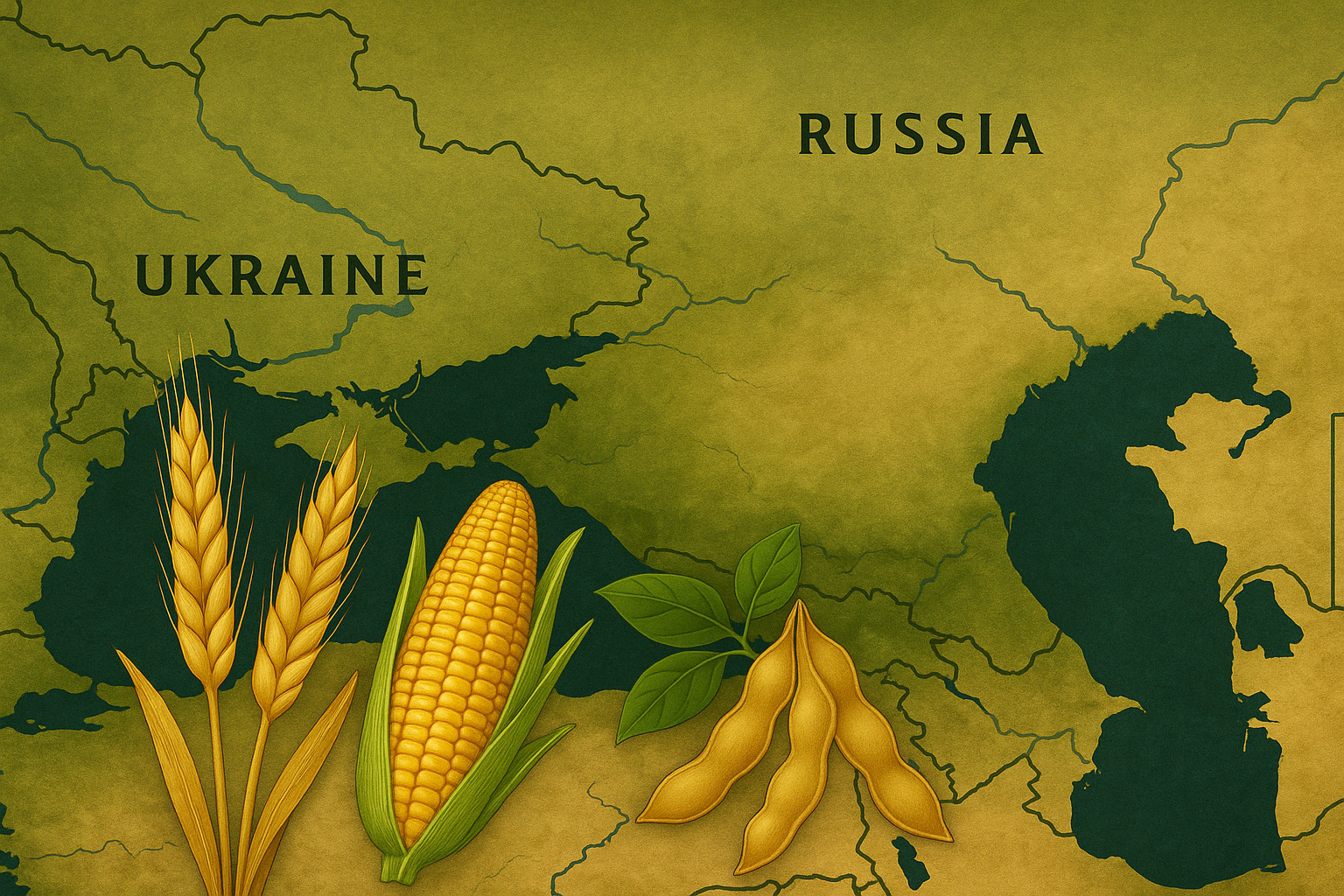
Ukrainian Exports Are Falling Dramatically
Ukrainian grain exports declined sharply in August following attacks on Black Sea ports. A total of 574,000 tonnes was exported by rail during the month, representing a 60% decline compared with the same period of the previous month, while total exports between August 1 and 21 reached just 539,000 tonnes compared with 1.73 million tonnes a year earlier. This removes a significant volume from the market precisely at a time when the Black Sea region normally plays a key role in global supply.
The Danube and Rail Transport Cannot Replace the Black Sea
Before the current restrictions, around 90% of Ukrainian grain exports moved through Black Sea ports. Rail infrastructure can direct around 1 million tonnes per month to land borders and around 500,000 tonnes to the Danube, while deep-water ports around Odesa are capable of handling up to 6 million tonnes per month. This makes a full replacement of maritime capacity practically impossible and keeps a geopolitical premium embedded in prices.
Danube Routes Are Also Reaching Their Capacity Limits
Up to 70 vessels are waiting near the Sulina Canal for access to Ukrainian ports, while shortages of pilots, air-raid alerts and an insufficient number of vessels available for loading are slowing operations. An additional constraint comes from low river levels, with flows in the Ukrainian section during the first half of August running at only 38–43% of normal. The Danube therefore remains a vital alternative route, but it cannot compensate for the loss of maritime capacity.
Ukrainian Corn Is Cheap but Difficult to Access
Logistical problems are creating large price differences between origins. Ukrainian feed corn is quoted at around €180/tonne FCA Odesa and €165/tonne FOB, compared with around €240/tonne FOB in France and around €292/tonne EXW in northern Germany. A cheap origin, however, has limited significance when actual access to the international market is constrained, making transport costs and physical availability more important factors than the warehouse price itself.
Russia Is Also Looking for Alternative Routes
Russia is facing a similar problem, with drone attacks affecting transport channels linked to around 70% of Russian grain exports. Measures under consideration include temporarily removing the export duty of around $12/tonne, subsidizing rail transport and using Baltic and Caspian ports. Even with Russian FOB prices around $210/tonne, physical execution remains difficult, which continues to support international quotations.
European Wheat Reacts Strongly to Black Sea Risk
On Euronext, December 2026 wheat rises to €240.25/tonne, while the September contract reaches €232.25/tonne. Continuing tensions between Russia and Ukraine and concerns over restricted supply are maintaining a risk premium in European prices. At the same time, the market expects international demand to become more active following the relatively weak start to the marketing year.
India Returns as a Potential Wheat Exporter
After more than four years of restrictions, India has once again allowed unrestricted exports of wheat and wheat products. Production in 2025/26 is estimated at 120.65 million tonnes, compared with 117.94 million tonnes a year earlier, while stocks remain high. The decision could add new supply to the global market and partially limit the price impact of the Black Sea crisis, although in the short term Indian wheat remains relatively expensive compared with international offers.
The European Corn Crop Remains Under Severe Weather Pressure
Drought and high temperatures continue to worsen prospects for spring crops across Europe. Western Romania, Hungary, Slovakia, the Czech Republic, Austria, parts of Germany, Italy and France are among the most severely affected areas. For some crops, yield forecasts are as much as 14% below the five-year average, with corn and sunflower among the most vulnerable. Subsequent rainfall may improve soil conditions, but for a large share of already affected crops it is arriving too late to restore the lost yield potential.
Oilseeds Remain Under Pressure from the Energy Complex
While grains are supported by geopolitics and weak harvests, rapeseed and sunflower remain more closely tied to movements in crude oil and vegetable oils. Euronext rapeseed futures weaken as crude oil declines, while falling soybean oil and palm oil prices add further pressure to the complex. This creates a more mixed picture across the European agricultural market, where restricted physical supply does not always translate directly into higher oilseed prices.
Logistics Remains the Most Important Driver for the Market’s Next Move
The main risk for the European and Black Sea grain market remains the physical ability of grain to reach buyers. Ukraine and Russia hold significant supplies, but transport restrictions, high insurance costs and congested alternative routes are reducing the volume that is effectively available to the market. As long as these problems persist, European and regional wheat and corn prices are likely to remain supported, even when nominal global supply remains sufficient.