




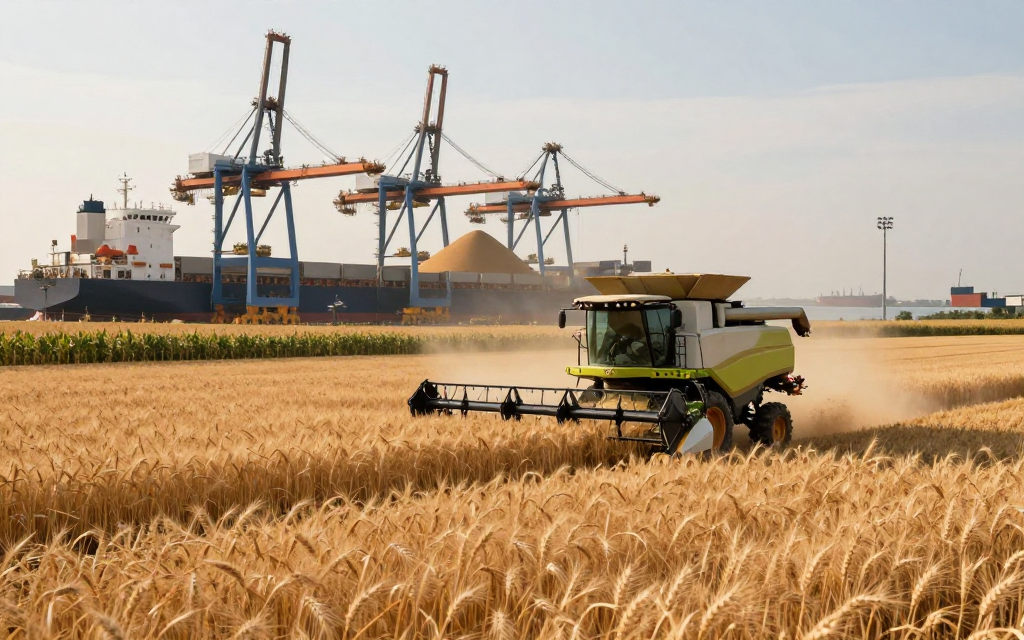
The grain complex splinters on the final session of April as wheat falls under delivery pressure and corn surges on a fresh flash sale, while the farm bill's passage without year-round E15 pushes that corn demand catalyst into a standalone May vote and the EPA's record biofuel mandates set a 60% biodiesel production increase target for 2026.
Friday opens with a sharp split in the grain complex: May '26 CBOT wheat is down 3 1/2 cents under month-end delivery pressure with 312 CBT and 578 KC notices issued overnight, corn is up 5 3/4 cents on a fresh 148,240 MT flash sale and solid export commitment data, and soybeans are mixed with nearby May down 1 1/2 cents while deferred contracts trade 3 to 8 cents higher as soy oil's biofuel bid holds firm. The US House passing the farm bill without E15 language is the day's most significant policy development for corn — removing that catalyst from the current legislative vehicle and delaying the structural demand addition to a standalone vote expected May 13.
Yara CEO Confirms Fertilizer Demand Rationing Is Already Under Way Globally
Yara International CEO Svein Tore Holsether delivered the week's most direct assessment of the fertilizer market's impact on production: "Demand rationing is happening." Egyptian urea — a key global benchmark — has jumped approximately 80% since the Iran war began, outpacing crop price gains and squeezing farmer margins to a breaking point. Holsether explicitly cited France's 15% corn area reduction, Australia's planted area decisions, and Africa as the most vulnerable region, where low baseline fertilizer usage means any further reduction "will lead to dramatic consequences for crops, food supplies and prices." The stark message from the world's second-largest fertilizer producer confirms that the price shock is already translating into production and area decisions — not just a future risk — and is the most structurally significant medium-term bearish supply signal for the global grain balance across all three crops. The direct implication is that the current-season IGC production estimates, already at record highs, face downward revision risk for 2027 if rationing spreads.
US Farm Bill Passes House Without E15 — Standalone Vote Set for May 13
The House passed its version of the farm bill 224 to 200 on Thursday, but the legislation reached the floor without the year-round E15 sales provision that corn markets had been tracking as a near-term structural demand catalyst since the amendment was filed earlier in the week. The E15 provision has been separated into a standalone bill expected to receive a House vote on May 13, with Senate passage still required before the measure becomes law. For corn, this is a neutral-to-modestly-bearish near-term development — the demand catalyst is delayed rather than eliminated, but the timeline extends beyond May's key WASDE reporting date. The farm bill as passed maintains farm subsidy frameworks and loan limits, with the American Farm Bureau Federation citing relief for farmers facing elevated input costs, while Democrats criticised it as insufficient against current margin pressures. Corn export commitments of 75.7 MMT as of April 23 — a 29% year-on-year increase at 90% of the USDA projection but 3 points behind the 93% pace — confirm underlying demand strength that partially offsets the E15 delay.
EPA Sets Record Biofuel Mandates Requiring 60% Biodiesel Production Increase in 2026
The EPA's 2026 and 2027 Renewable Volume Obligations — set at 5.4 billion and 5.7 billion gallons respectively, up from 3.35 billion last year — represent the most ambitious biofuel mandates in US history and require a greater than 60% increase in biomass-based diesel production this year alone. Industry leaders and analysts warn the target is at risk of not being met, with EIA data released Thursday showing February soybean oil used for biodiesel at a 7-month high at 1.058 million lbs, accounting for 44.34% of the overall feedstock mix. Analysts cited at the FT earlier in the week noted "we have to import" to meet the new targets, given insufficient domestic feedstock supply — a structural soy oil demand signal that explains the persistence of D4 RIN values above $1.90 per gallon and soy oil's continued premium relative to other vegetable oils. The March crush data due later this afternoon from USDA's monthly Fats & Oils report — with traders expecting 231.1 million bushels of crush and 2.555 billion lbs of soy oil stocks — will serve as the day's key demand verification data point for the soy complex.
Indonesia Tightens Wheat and Soymeal Import Rules Effective May 8
Indonesia — the world's largest wheat buyer with over 13 million tons of annual imports — announced that effective May 8, importers of feed wheat, soymeal, and other agricultural products will require an endorsement from the agriculture ministry prior to purchase, adding a regulatory layer to the procurement process. The measure is explicitly designed to protect domestic corn farmers from cheap imported competition. For US and Australian wheat exporters, the additional approval requirement introduces a potential logistical delay into the world's largest single-country wheat import programme. Indonesia is also the world's third-largest soymeal importer. Combined with last week's Quequen port disruption, this week's EU GMO soymeal withdrawal of Argentine and Brazilian shipments, and China's structural import reduction trajectory, the Indonesian regulation adds another layer of friction to South American soymeal flows in the world's fastest-growing protein import region. Indonesia's May crude palm oil reference price was simultaneously set at $1,049.58 per ton — up from $989.63 in April — raising the export tax to $178 per ton and tightening palm oil export economics.
Safrinha Corn Dryness Intensifies; Central Brazil Soil Moisture Running Out
Friday's weather update confirms that central Brazil — the core safrinha corn growing states of Mato Grosso and Goiás — has entered a dangerously dry period as the wet season ended approximately two weeks early. The CEPEA weekly analysis described corn prices as showing "limited trading activity" amid uncertainty, while sellers in São Paulo held firm and Central-West prices declined on progress in the summer soybean harvest — masking the developing weather risk. CEPEA's ESALQ/BM&F corn index for Campinas rose 0.8% in the April 23-29 period to BRL 66.91 per 60-kg bag. Fronts moving up from Argentina may occasionally provide scattered showers, but the fundamental message is unchanged: soil moisture is running out rapidly at precisely the period when safrinha corn requires consistent moisture for filling. If central Brazil does not receive meaningful rainfall in early May, the CONAB safrinha estimate of approximately 109 MMT faces the most significant downward revision risk of the 2025/26 season — a development that would materially tighten the global corn balance ahead of the May 12 WASDE.
Cargill's $150 Million French Sunflower Upgrade and EU Grain Outlook Revisions Reflect Shifting Protein and Crop Dynamics
Cargill announced a $150 million upgrade to its Saint-Nazaire, France sunflower processing facility to shift from standard to high- and super-high protein sunflower meal, with commissioning planned for March 2029. The investment signals growing European processor confidence in demand for high-value alternative protein meals — a trend that is directly connected to the EU GMO soymeal compliance crisis flagged earlier this week. If South American soymeal faces sustained regulatory friction in the EU, competing protein meals including sunflower meal gain structural market share. The European Commission simultaneously released its latest grain production forecast, trimming total EU 2026/27 grain output to 277.6 MMT from 278.1 MMT — down 4.5% year-on-year — with barley revised down 1.8 MMT to 52.9 MMT while soft wheat was raised 1.4 MMT to 127.3 MMT. France's FranceAgriMer showed soft wheat at 81% good/excellent, down 2%, with durum dropping 9 percentage points to 72% — the ongoing EU spring crop stress reflecting the same fertilizer-and-input-cost pressures driving US and Australian area reduction decisions.
Ukraine's Stolen Grain Campaign Scores First Win as Panormitis Leaves Israel
The vessel Panormitis — carrying grain Ukraine alleges was stolen from Russian-occupied territories — departed Israeli waters on Thursday without unloading, after Ukraine engaged in legal proceedings and diplomatic pressure on Israeli authorities. Foreign Minister Sybiha declared the outcome "a clear signal to all other vessels, captains, operators, insurers, and governments: do not buy stolen Ukrainian grain." Israel stated that Ukraine's legal assistance request "contained significant factual gaps," and that the vessel departed independently — an ambiguous outcome that satisfies neither side's narrative fully, but effectively demonstrates that Ukrainian grain sanctions diplomacy can create commercial uncertainty sufficient to deter port unloading. Zelenskiy confirmed Ukraine would systematically pursue the "shadow grain fleet" using the same approach applied to Russia's shadow oil fleet. For global wheat markets, the extension of this campaign increases insurance and compliance risk for vessels carrying Black Sea-origin grain of disputed provenance, potentially increasing shipping costs for that origin over time.
Mississippi River Barge Rates Edge Higher; Soybean Shipments Fall Sharply
USDA's weekly grain transportation report showed Mississippi River barge grain shipments declining to 638,000 tons in the week ending April 25 from 720,000 tons the prior week, with soybean shipments down 29.3% week-on-week. St. Louis barge rates edged to $18.15 per short ton, up $0.04 from the prior week. Corn shipments rose 2.9% on the week. The sharp drop in soybean barge shipments reflects both the seasonal slowdown in old-crop movement and the low US export sales pace — old-crop soybean commitments at 38.776 MMT are 18% below the same week last year and 4 percentage points behind the 5-year average at 93% of the USDA projection. The infrastructure note from Kalshi — which agreed Friday to limit its new agricultural commodity contracts to traditional trading hours following pushback from CME Group, Cargill, and the Commodity Markets Council — confirms that the traditional grain market microstructure is defending its liquidity and price-discovery monopoly at a moment when prediction markets are seeking entry into the sector.
Wheat
May '26 CBOT wheat is at $6.20 1/4, down 3 1/2 cents, as month-end profit-taking and 312 CBT plus 578 KC first-notice-day delivery notices weigh on the nearby contract — the first meaningful pullback after three consecutive sessions of double-digit gains. Deferred contracts are up 1 to 2 cents, confirming the selling is concentrated in expiring May positions rather than representing a reversal of the fundamental bullish thesis. Total wheat export commitments of 24.859 MMT are 102% of the USDA projection, matching the 5-year average pace, while old-crop export sales of 226,096 MT for the week of April 23 were a 5-week high and well above the same week last year. SovEcon raising Russian 2025/26 wheat exports to 47.4 MMT and 2026/27 to 45.2 MMT — citing stronger demand and good southern Russia crop prospects — sustains the competitive pressure on US wheat from Black Sea origin, but the Drought Monitor's 70% drought coverage for US HRW and the Brugler500 state average at 244 remain the fundamental anchors of the bullish multi-week move.
Corn
May '26 CBOT corn is at $4.70 1/2, up 5 3/4 cents — the day's standout performer and the sharpest single-session gain in the corn complex this week. A fresh USDA flash sale of 148,240 MT to unknown destinations — split 78,240 MT old-crop and 70,000 MT new-crop — was announced Friday morning and is the primary driver. Marketing year corn export commitments of 75.7 MMT are 29% above year-ago pace, though at 90% of the USDA projection they trail the 93% five-year average by 3 points. The farm bill passing without E15 delays the year-round sales provision to a standalone House vote expected May 13, extending the timeline without removing the catalyst. Old-crop export sales of 1.598 MMT for the week of April 23 — the largest since late February — confirm physical demand is intact and provides the fundamental basis for Friday's gains alongside the fresh flash sale.
Soybeans
May '26 CBOT soybeans are at $11.80 1/2, down 1 1/2 cents, while deferred contracts trade 3 to 8 cents higher in a split that reflects delivery liquidation pressure on the expiring May contract against a constructive forward demand outlook. Soy oil is up 22 to 42 points as the EPA's record RVO of 5.4 billion gallons for 2026 — a 60% production increase requirement — and February's 7-month-high soy oil biodiesel usage at 44.34% of feedstock confirm the structural biofuel demand bid. Soymeal is steady to $1.70 lower as the EU GMO crisis, while still supportive, has not yet generated a definitive enforcement decision from Brussels to shift the near-term trade flow. Total soybean commitments of 38.776 MMT are 18% below the same week last year, and with old-crop sales of 258,066 MT for the week of April 23 — the second-lowest of the marketing year — the export programme remains the complex's most persistent structural weakness heading into the May WASDE.