




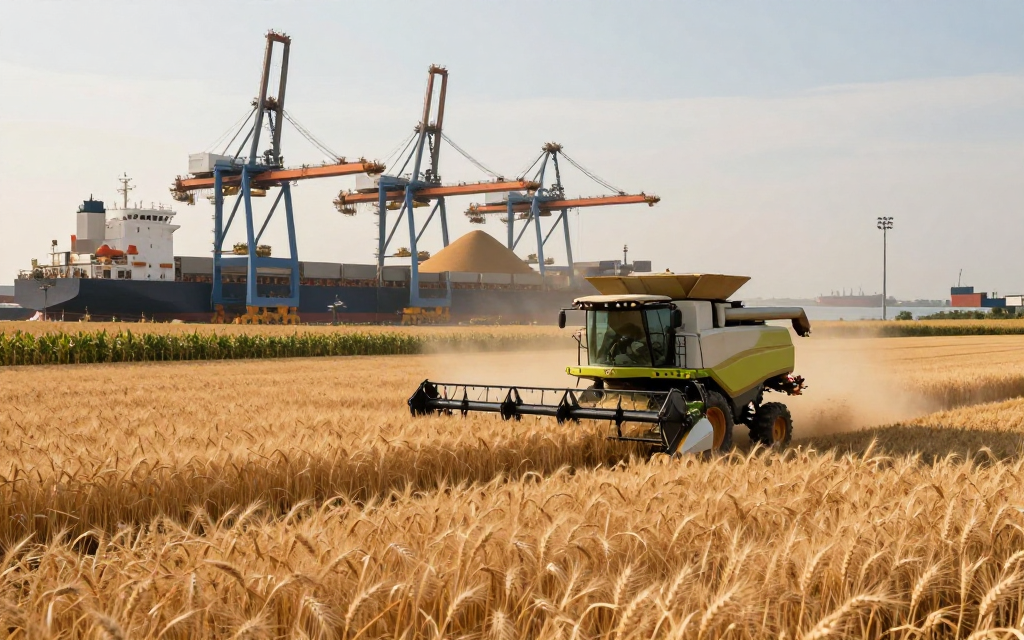
Wheat surges double digits across all three exchanges on Tuesday as the Brugler500 HRW average plunges to its second-lowest level since 2000, while soybeans retreat on Turnaround Tuesday as soy oil and soymeal diverge and an ahead-of-schedule corn planting pace offers reassurance on the crop side.
Grains open Tuesday with a striking split: wheat is 20 to 25 1/2 cents higher across all three exchanges as the Crop Progress data delivered the most alarming HRW condition reading in over two decades, corn trades 2 to 5 cents higher on planting progress and spillover from wheat strength, while soybeans retreat 2 to 6 1/2 cents in a classic Turnaround Tuesday reversal following Monday's 15-cent surge. Soy oil gains 55 to 65 points on energy linkage while soymeal falls $2 to $2.50, with India's fertilizer subsidy bill heading for a 20% annual increase and Brazil's ethanol blend boost projecting 1 billion liters of additional anhydrous demand framing the day's two most consequential structural stories.
Brugler500 HRW Average Hits Second-Lowest Level Since 2000 — Drought Stress Becoming Historic
Monday's USDA Crop Progress report delivered the week's most alarming data point for wheat: the average Brugler500 index for the main HRW states fell to 244 — the second-lowest reading for this week going back to 2000. The national winter wheat condition rating held unchanged at 30% good/excellent on the surface, but the underlying detail tells a far more damaging story. The Brugler500 index dropped 3 more points to 287 as fair-condition acres shifted into poor (+1%) and very poor (+1%). Colorado fell 13 points, Montana 18, Nebraska 26, North Carolina 16, and Oregon 19, while Kansas slipped 2 and Texas 3. The only states showing improvement were Arkansas (+35), Illinois (+2), Indiana (+1), and Oklahoma (+1) — all SRW or transitional-territory states. With winter wheat heading at 34%, now 13 percentage points ahead of normal, the crop is racing through yield-determining growth stages at precisely the moment soil moisture is most critically depleted. This is the dominant bullish driver for the entire wheat complex on Tuesday and provides the structural justification for the 20 to 25 1/2 cent KC HRW gains.
India to Import Record 2.5 MMT of Urea at Double Pre-War Prices; Fertilizer Subsidy Bill Rising 20%
India's fertilizer ministry confirmed the country expects its annual fertilizer subsidy bill to rise approximately 20% for the current financial year due to the Middle East price surge. India has placed orders for a record 2.5 MMT of urea imports at nearly double the prices paid two months ago, representing approximately a quarter of India's annual import requirement. The Middle East accounts for roughly half of India's DAP and urea imports, with Saudi Arabia the largest DAP supplier and Oman the largest urea supplier — both Gulf-region sources directly affected by the Hormuz disruption. India's demand for rice, corn, cotton, and oilseeds peaks in June and July when planting begins, meaning the current record urea procurement is a forward-purchase against peak seasonal need. With global urea having already fallen 8.1% to $653 per short ton at US Gulf NOLA in the week ending April 24, India's record purchases — estimated to tighten global supply and push prices higher — introduce a reflexive upward price pressure dynamic that is directly bullish for all crops via input cost inflation and potential planted area responses in price-sensitive producing countries.
Ukraine Announces Grain Sanctions Against Vessels Carrying Stolen Cargo; Israel Shipment Confirmed
President Zelenskiy announced that a second vessel carrying grain stolen from Russian-occupied Ukrainian territories has arrived at an Israeli port, and that Ukraine is preparing sanctions targeting those transporting and profiting from the cargo. Ukraine will coordinate with European partners to include relevant individuals in EU sanctions frameworks. This development adds a geopolitical grain trade disruption risk outside the existing Hormuz and Black Sea shipping frameworks, as Israeli port authorities — and potentially EU-flag vessel operators — may face compliance risk if Ukrainian sanctions are formalized. The volume involved in any single vessel is not market-moving in isolation, but the precedent of extending stolen-grain sanctions to destination-country ports could escalate into a broader shipping compliance issue that affects Black Sea-origin flows over time. Combined with the PhosAgro plant strike on Sunday, Ukraine is demonstrating a widening tactical toolkit to disrupt Russian commodity export earnings.
Russia Boosts Q1 Oilseed Exports 29%, Sunflower Oil Up 26% — Competitive Pressure on Soy Complex
Russia exported 933,000 tons of oilseeds in Q1 2026, up 29% year-on-year, with soybean exports surging 2.2-fold to 409,000 tons — primarily to China at 267,000 tons. Vegetable oil exports rose 19% to 2 million tons, led by a 26% increase in sunflower oil to 1.36 million tons, with India at 457,000 tons and Turkey at 261,000 tons as the principal buyers. Soybean meal exports rose 1.9-fold to 237,000 tons. The surge in Russian oilseed and vegetable oil exports directly displaces demand for US and South American soy complex products in key destination markets. India absorbing 457,000 tons of Russian sunflower oil is equivalent to demand that would otherwise partially support soy oil or palm oil from competing origins. Combined with COFCO's Brazil crushing investment and China's structural import reduction trajectory, the expanding Russian vegetable oil footprint is a medium-term structural bearish factor for US soybean export programmes.
Corn Planted at 25% — Six Points Ahead of Average; Severe Weather Briefly Slows Progress
NASS Crop Progress showed the US corn crop at 25% planted as of Sunday, 6 percentage points ahead of the 5-year average pace of 19%, with emergence at 7% — 3 points above average. Illinois is 10 points ahead, Indiana 20 points ahead, Nebraska 10, and Ohio 14 — with only Kansas, Michigan, Missouri, North Carolina, North Dakota, and Wisconsin running behind average. The Midwest is experiencing a severe weather outbreak on Monday — tornadoes, winds, and hail — which will briefly slow planting progress but is not expected to cause flooding. South Korea purchased 60,000 MT of corn overnight in a tender, and Taiwan issued a 65,000 MT corn tender with offers due Wednesday, adding near-term demand breadth alongside the marketing year inspection total of 53.441 MMT now running 30.64% above year-ago pace. The well-ahead planting pace provides a modestly bearish crop establishment counterweight to the bullish external wheat-linked spillover, with corn trading 2 to 5 cents higher rather than following wheat's double-digit surge.
Brazil E32 Ethanol Blend to Add 1 Billion Liters of Annual Demand; UNICA Confirms Corn-Ethanol Absorption Capacity
UNICA — Brazil's sugarcane industry group — confirmed that the planned move to a 32% ethanol blend in gasoline (E32) from the current 30% will boost annual anhydrous ethanol demand by approximately 1 billion liters, or 2.4 billion liters compared with the E27 baseline in place until August last year. UNICA stated the sector has sufficient installed capacity to meet the additional demand from both cane and corn-based ethanol sources, and that corn ethanol expansion alone could absorb the incremental requirement. A higher ethanol blend is expected to increase the share of sugarcane processed into biofuel while simultaneously supporting corn-ethanol plant utilization — a structural demand-positive for Brazilian corn. The CNPE energy council is expected to formally discuss the E32 proposal at its next meeting in early May. This development, combined with Indonesia's B50, Malaysia's B15, Thailand's B7, and the US E15 Farm Bill amendment advancing to the House Rules Committee, represents the week's broadest coordinated biofuel demand expansion signal across all major producing economies.
Soybeans at 23% Planted — Well Ahead of Pace; Soy Oil-Meal Divergence Continues
NASS Crop Progress showed US soybeans at 23% planted as of April 26, against a 12% five-year average, with emergence at 8% versus 1% average — one of the most dramatically ahead-of-schedule spring plantings on record for this crop. Illinois is 18 points ahead of average, Indiana 27 points, Minnesota 9, Nebraska 11, and Ohio 12. The well-ahead planting pace is structurally bearish for soybeans by reducing weather-related growing concern, and aligns with Monday's soybean retreat as profit-taking follows Friday's and Monday's combined gains. The soy oil-soymeal split deepened Tuesday: soy oil up 55 to 65 points as energy linkage from the Iran war and biofuel mandates sustains the vegetable oil premium, while soymeal falls $2 to $2.50 as long liquidation continues. The CEPEA data from Brazil confirms the structural story — soy oil's share of crush margins reached a series record of 52.1% on April 23, surpassing soymeal for the first time — and Tuesday's session replicates that divergence in CBOT prices.
Wheat
May '26 CBOT wheat is at $6.42 1/4, up 20 3/4 cents on Tuesday — the complex's strongest intraday gain of the week and among the largest single-session moves of the month. The Brugler500 HRW average for the main producing states falling to 244 — the second-lowest reading for this week since 2000 — is the primary driver, with Nebraska down 26 points, Montana down 18, and Colorado down 13 in a single week. Winter wheat heading at 34%, 13 percentage points ahead of normal, means the crop is accelerating through pollination at critically low soil moisture levels. EU soft wheat exports from July 1 to April 24 reached 19.28 MMT, up 1.18 MMT year-on-year, confirming the competitive backdrop remains intact from European origin — but it is not sufficient to offset the HRW deterioration narrative today. India's additional 2.5 MMT export quota notification provides a forward supply headwind, but Monday's Saudi 985,000 MT tender award and the unprecedented drought severity are keeping buyers engaged across all three classes.
Corn
May '26 CBOT corn is at $4.63, up 2 1/4 cents — benefiting from wheat spillover support while the crop's own fundamentals remain broadly neutral to modestly positive. Corn planting at 25% — 6 percentage points ahead of the 5-year average — is the most constructive crop progress reading in the complex, and with emergence at 7% versus 1% average, establishment is proceeding rapidly across the major Midwest states. A South Korean overnight purchase of 60,000 MT and Taiwan's 65,000 MT tender with Wednesday offers add near-term demand texture. Marketing year corn inspections at 53.441 MMT, 30.64% above year-ago pace, maintain the structural export demand story. Brazil's E32 ethanol mandate discussion is a medium-term positive for corn-ethanol demand — UNICA confirmed corn ethanol expansion could absorb the 1 billion liter increment on its own — though Tuesday's session is content to trade modestly firmer in wheat's shadow rather than as an independent leader.
Soybeans
May '26 CBOT soybeans are at $11.70 3/4, down 6 1/2 cents in a Turnaround Tuesday reversal after Monday's 15-cent rally. The retreat reflects profit-taking on the soybean grain position, with soy oil's 55 to 65 point gain and soymeal's $2 to $2.50 decline confirming the split is driven by the energy-versus-protein demand divergence rather than a uniform complex move. Planting at 23% — 11 points ahead of average — reduces the weather risk premium that a slower pace might otherwise support. Russia's Q1 soybean export surge to 409,000 tons, 2.2-fold above year-ago and primarily to China, is a structural bearish overlay reinforcing the US origin displacement narrative. China-bound soybean inspection shipments of 247,000 MT out of 629,000 MT total for the week of April 23 confirm near-term flows remain concentrated in China — but structurally, the combination of COFCO's Brazil investment, Russia's expanding oilseed export programme, and China's decade import reduction outlook continue to cap the medium-term upside for US soybeans.