




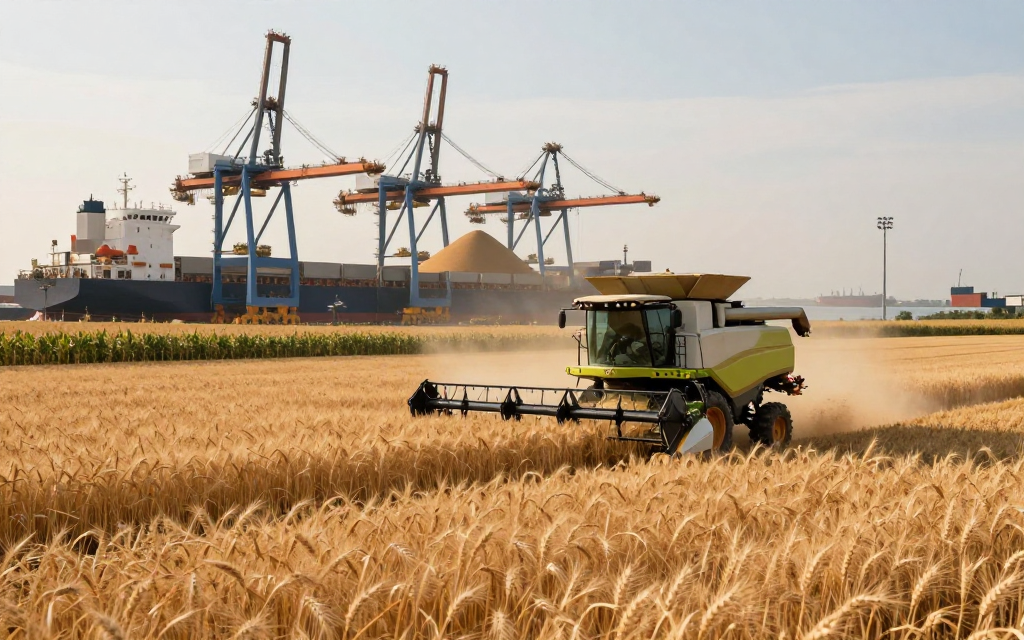
Winter wheat conditions falling to 27% good/excellent with HRW states averaging a Brugler500 of 220 confirm the crop is worsening by the week, but corn and soybean planting running 6 and 14 percentage points ahead of average caps the supply-risk premium across the row crop complex.
Grain markets settle into a quieter consolidation session on Tuesday following Monday's explosive gap-up on the White House China fact sheet. Wheat is holding modest 4 to 6 cent gains on continued condition deterioration and harvest-delaying rain forecasts, corn is fractionally lower as the planting pace story turns mildly bearish, and soybeans are mixed with new crop outperforming on a fractional to 5 cent gain — a session defined by digestion of Monday's move rather than new directional conviction.
Winter Wheat Conditions: The Crop Keeps Getting Worse
Tuesday's Crop Progress update delivered another round of deterioration for the winter wheat complex. The national good/excellent rating fell 1 percentage point to 27% — the Brugler500 index dropped 6 points to 271. The HRW state average Brugler index fell a further 7 points to 220, with Kansas and Colorado down 12 points, Texas down 11 points, and Missouri dropping 8 points. These are not stabilising numbers — they are a continued downward drift in crop quality that confirms the stress documented by the Kansas Wheat Quality Tour's 38.9 bpa composite is ongoing rather than arrested. Winter wheat is now 71% headed — 13 percentage points ahead of normal — meaning the crop is racing through its development stages under drought stress, compressing the grain fill window and locking in yield losses that rain this week will be unable to reverse. The SRW state average improved just 1 point to 359 on the Brugler500, with white wheat states up 1 point to 383 — confirming the stress is overwhelmingly concentrated in the HRW belt.
Southern Plains Rain Forecast: Too Late for Yield, But Enough to Delay Harvest
Rains are expected across much of the Southern Plains in the next week — a development that is simultaneously irrelevant for yield and potentially disruptive for logistics. At 71% headed and with conditions at 25-year lows, the crop has already locked in its yield trajectory for the 2026 season; moisture now cannot recover kernels that have not set or bolster a crop already physiologically committed to its final size. What the rain will do is delay the early harvest that was expected to begin around May 15 given the drought-accelerated development pace. For wheat traders, delayed harvest means a longer period of price uncertainty without the reality check of actual bin weights — a mild supportive factor that extends the window for weather-premium maintenance. For the KC HRW basis, harvest delays can temporarily tighten nearby spreads as elevators manage inventory ahead of new crop arrival.
US Spring Wheat Planting: 73% Complete and 7 Points Ahead of Average
Spring wheat planting reached 73% as of May 17 — 7 percentage points ahead of the five-year average pace of 66% — with emergence at 39%. Montana and Washington were the only states reporting below-normal planting pace, reflecting localised moisture or temperature delays in the northern half of the spring wheat belt. The strong planting pace is a mildly bearish spring wheat supply signal: a well-planted spring wheat crop reduces the probability of a shortened growing season from planting delays, underpinning normal yield assumptions heading into the summer. For MPLS spring wheat, which is trading fractionally mixed at midday, the planting data provides no incremental bullish justification for premium pricing and is consistent with the flat price action in that market.
Corn Planting at 76%: Six Points Ahead, Row Crops Racing Through the Calendar
US corn planting reached 76% as of May 17 — 6 percentage points ahead of the five-year average of 70% — with emergence at 39%, two percentage points faster than normal. Kansas, Michigan, and North Carolina are the only states tracking behind average pace. The exceptional planting progress is the week's most structurally bearish data point for corn: a crop that enters the ground early, emerges quickly, and faces no planting-window compression has the highest probability of achieving or exceeding the USDA's initial 183 bushels per acre yield assumption from the May WASDE. For corn bulls, the planting data removes a key weather-risk premium that might otherwise have built into prices as May progresses. The national average cash corn price is down 1 cent to $4.36 3/4 at midday, consistent with a market that is absorbing positive supply news without a fresh demand catalyst on the day.
South Korean Corn Tender: 135,000 MT Overnight — Demand Pulse Continues
A pair of South Korean importers purchased a combined 135,000 MT of corn in separate overnight tenders — a volume consistent with the recurring Korean demand that has been a weekly feature of the marketing year's export picture. Korea's consistent presence as an end-user buyer at current price levels provides a demand floor beneath corn and is part of the reason corn's marketing year commitments are running 25% above year-ago. Tuesday's 135,000 MT tender is insufficient to reverse corn's fractional midday losses — it is absorbed as routine demand rather than a market-moving surprise — but it confirms that elevated US FOB competitiveness is still attracting business even as Argentina's record 67–68 MMT harvest increases competing origin availability. The ongoing South Korean tender activity will need to be replicated at higher aggregate volumes to tighten the commitment pace gap of 2 percentage points below the 95% average sales pace.
Soybeans: New Crop Leads, Brazil's May Export Estimate Holds Steady
Tuesday's soybean session sees new crop outperforming old crop in a fractional to 5 cent gain range — a spread-widening dynamic that reflects traders repricing the 2026/27 balance sheet following Monday's China commitment confirmation rather than adjusting current marketing year flows. Jul '26 soybeans are at $12.13 1/2, up just 1/2 cent, while new crop contracts are showing the stronger bid. Brazil's ANEC estimate for May soybean exports was revised up 0.1 MMT to 16.1 MMT — a minor adjustment that keeps the South American export pipeline running at a pace competitive with the US, providing the key bearish supply offset to Monday's China demand signal. US soybean planting reached 67% as of May 17 — 14 percentage points above the 53% average pace — with emergence at 32% versus 23% on average. Michigan was the only state below average pace. The historically fast planting pace, combined with Brazil's strong May export flow, creates a well-supplied near-term picture that limits Tuesday's soybean upside to modest new crop gains rather than a continuation of Monday's broad rally.
Soymeal Softens, Soy Oil Holds: Internal Complex Divergence Returns
Tuesday's intraday complex dynamics show soymeal down 80 cents to $1.30 and soy oil steady to 12 points higher — a mild internal divergence that reverses Monday's unified strength. The softening in meal is consistent with a session where no new Chinese purchase announcement has landed to follow up Monday's White House fact sheet, and where Brazil's 16.1 MMT May export estimate keeps South American origin supply flowing. Soy oil's flat to slightly firmer tone reflects the underlying biofuel mandate support — with the EPA's 5.4 billion gallon biodiesel mandate and Indonesia's B50 trajectory providing a structural demand floor — though the abundant oil stocks at 1.947 billion pounds limit the oil leg's ability to lead the complex higher. For Tuesday specifically, the meal/oil divergence suggests the market is in price discovery mode rather than committing directionally to either leg of the complex ahead of this week's Export Sales data.
Export Sales Thursday: The Week's Key Demand Validation
Thursday's Export Sales report is the session most traders are watching as the week's primary scheduled catalyst. The data will cover the week ending May 15 — capturing the final days before the White House fact sheet was released on Sunday — meaning any Chinese purchases that materialised in response to the Beijing summit would not yet appear in this week's data. For wheat, new crop sales pace is the primary variable after commitments crossed 102% of the USDA estimate last week. For corn, the market will be looking for recovery from last week's disappointing 684,786 MT old crop figure. For soybeans, the marketing year low of 102,059 MT from last week needs to be sharply reversed — though given the May 15 data cutoff, the China $17 billion commitment's demand acceleration is more likely to appear in the following week's data. The report is expected to show a modest improvement across crops from last week's weak numbers, but the transformational demand shift from Monday's White House announcement will not be quantifiable in Export Sales until the week ending May 22 report.
Crop Futures Wrap
Wheat — Jul '26 CBOT SRW wheat is at $6.69 3/4, up 5 1/4 cents at Tuesday midday. Chicago SRW is 5 to 6 cents higher across contracts, KC HRW is up 4 to 5 cents, and MPLS spring wheat is showing fractionally mixed action — a uniform but modest bid that reflects ongoing fundamental support rather than fresh momentum from Monday's gap. Winter wheat conditions falling to 27% good/excellent with the Brugler500 at 271 — and HRW states collapsing a further 7 points to a Brugler average of 220 — confirm the crop stress is deepening rather than stabilising. The Southern Plains rain forecast will delay early harvest but cannot recover yield, keeping the structural supply tightness from Tuesday's WASDE intact. Spring wheat at 73% planted — 7 points ahead of average — is a neutral to mildly bearish offset specific to the MPLS market.
Corn — Jul '26 CBOT corn is at $4.76, down 1 cent at Tuesday midday. The national average cash corn price is down 1 cent to $4.36 3/4. Corn planting at 76% — 6 points ahead of the five-year average — and emergence at 39% — 2 points ahead — are the session's dominant supply-side inputs, and both are directionally bearish at the margin by reducing the probability of yield-damaging planting delays materialising. The South Korean overnight tender of 135,000 MT provides incremental demand support that is keeping losses contained rather than generating upside. Monday's 16 cent gap from the China fact sheet is the primary level the market is consolidating around, with Thursday's Export Sales the next scheduled catalyst to either validate or test that new price floor.
Soybeans — Jul '26 CBOT soybeans are at $12.13 1/2, up 1/2 cent at Tuesday midday, with new crop showing the firmer bid of up to 5 cents across deferred contracts. The national average cash bean price is up 3/4 cent to $11.50 3/4. Soymeal is down 80 cents to $1.30 and soy oil is steady to 12 points higher — a mild reversion to the familiar meal-weak, oil-firm divergence that has characterised much of the marketing year. Brazil's May soybean export estimate from ANEC of 16.1 MMT — unchanged at the margin — keeps South American competitive supply flowing. US soybean planting at 67% — 14 percentage points above average — and emergence at 32% versus 23% normal is the most aggressively ahead-of-schedule row crop planting picture of the three major crops, establishing a strong baseline for the USDA's 53 bpa new crop yield assumption. Thursday's Export Sales will be the first scheduled data test of whether China's $17 billion commitment is beginning to generate verifiable purchase flows.